

- Advertisement -
Rosehips Skin Benefits | 7 Science-Backed
Rosehips Skin Benefits | The Complete Guide to Glowing, Youthful Skin


- Advertisement -
Rosehips Skin Benefits
Let’s be real — the skincare world is flooded with miracle ingredients every single season. One week it’s snail mucin, the next it’s some exotic algae extract from the depths of the Pacific. But every once in a while, an ingredient comes along that actually lives up to the hype. Rosehips is one of those rare gems.
Used for centuries in traditional medicine across Europe, South America, and parts of Asia, rosehips have quietly earned a reputation as one of nature’s most powerful skin healers. And now science is backing up what grandmothers have known for generations. Whether you’re dealing with dull skin, fine lines, dark spots, or dryness, rosehips might just be the ingredient your routine has been waiting for.
So, what exactly makes rosehips so special for your skin? Let’s break it all down.
What Are Rosehips, Exactly?
Before we dive into all the glorious skin benefits, it’s worth taking a moment to understand what rosehips actually are. Spoiler alert: they’re not roses.
The Difference Between Rosehips and Rose Petals
Rosehips are the small, round fruit that a rose plant produces after its flowers have bloomed and the petals have fallen away. Think of them as the “apple” of the rose plant — they’re the seed-bearing fruit left behind after pollination. They’re typically red, orange, or sometimes deep burgundy in color, and they’re packed with nutrients that the petals themselves don’t even come close to matching.
So if you’ve been using a rose water toner thinking you’re getting rosehip benefits, well — you’re enjoying something lovely, but it’s a completely different thing.
Where Do Rosehips Come From?
Rosehips grow on various species of wild rose plants, but the most prized variety for skincare comes from Rosa canina (the dog rose) and Rosa rubiginosa (the Chilean wild rose). The Chilean variety, in particular, is the source of the famous rosehip seed oil widely used in premium skincare. These plants thrive in cool, mountainous climates — particularly in the Andes of South America — where the harsh conditions actually push the plants to produce higher concentrations of beneficial compounds.

The Science Behind Rosehip Skin Benefits
Here’s where things get genuinely exciting. Rosehips aren’t just trending because of beautiful packaging or clever marketing. The science is solid, and it points to a truly impressive nutritional profile.
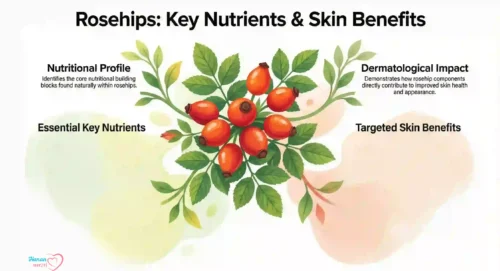
Key Nutrients Found in Rosehips
| Nutrient | Role in Skin Health |
|---|---|
| Vitamin C | Boosts collagen synthesis, brightens skin |
| Vitamin A (Retinoic Acid) | Speeds cell turnover, reduces wrinkles |
| Linoleic Acid (Omega-6) | Strengthens skin barrier, reduces inflammation |
| Alpha-linolenic Acid (Omega-3) | Hydrates, soothes sensitive skin |
| Vitamin E | Protects against oxidative damage |
| Beta-carotene | Antioxidant, improves skin tone |
| Lycopene | UV protection, anti-aging |
Vitamin C Content and Why It Matters
Rosehips contain one of the highest concentrations of vitamin C found in any plant — up to 20 times more than oranges, depending on the variety and preparation method. Why does that matter for your skin? Vitamin C is essentially collagen’s best friend. It’s a critical cofactor in the synthesis of collagen, the protein that keeps your skin firm, plump, and youthful-looking. Without adequate vitamin C, collagen production slows — and that’s when you start seeing sagging and fine lines.
Beyond collagen, vitamin C is a powerful antioxidant that neutralizes free radicals from UV exposure and environmental pollution. Think of it as your skin’s personal bodyguard, standing between your cells and everything the world throws at them.
Essential Fatty Acids in Rosehip Oil
Rosehip oil — particularly the cold-pressed version extracted from the seeds — is extraordinarily rich in essential fatty acids, specifically linoleic acid and alpha-linolenic acid. These are the omega-6 and omega-3 fatty acids your skin absolutely loves. Here’s the thing about essential fatty acids: your body cannot produce them on its own. You have to get them externally. And when your skin is deficient in them, the result is a compromised skin barrier — meaning more water loss, more sensitivity, and more inflammation.
Applying rosehip oil delivers these fatty acids directly to where they’re needed most, helping to repair and reinforce that all-important barrier.
Antioxidants and Phytonutrients
Beyond vitamins C and E, rosehips are loaded with polyphenols, carotenoids like lycopene and beta-carotene, and flavonoids. These compounds collectively fight oxidative stress — the underlying driver of premature skin aging. A 2015 study published in the Journal of Nutritional Science and Vitaminology found that rosehip powder supplementation significantly reduced skin aging indicators including crow’s feet wrinkles, skin moisture loss, and skin roughness.
Top Rosehips Skin Benefits You Need to Know
Now let’s get into the good stuff. Here are the most well-documented and impactful ways rosehips can transform your skin.
Anti-Aging and Wrinkle Reduction
If there’s one rosehip skin benefit that gets the most attention, it’s anti-aging. And for good reason. The combination of vitamin C (for collagen synthesis), vitamin A (for cell turnover), and powerful antioxidants makes rosehip one of the most comprehensive anti-aging ingredients in natural skincare.
Vitamin A, found naturally in rosehip oil as retinoic acid and beta-carotene, functions similarly to retinol — it accelerates skin cell turnover, pushing fresher, newer cells to the surface while sloughing off the dull, damaged ones. This translates to smoother texture, fewer visible fine lines, and a more youthful overall appearance.
Key Takeaway: Rosehip oil offers a gentler, natural alternative to synthetic retinol — making it ideal for those with sensitive skin who can’t tolerate harsher retinoid treatments.
Brightening and Evening Skin Tone
Struggling with dull, uneven skin? Rosehips are your answer. The high vitamin C content directly inhibits melanin production by interfering with the enzyme tyrosinase, which is responsible for producing the pigment that causes dark spots. Regular use of rosehip oil or rosehip-based serums can visibly brighten the complexion over time, fading hyperpigmentation and giving skin that coveted luminous glow.
This makes rosehip particularly beneficial for:
- Post-acne dark marks.
- Sun spots and age spots.
- Melasma (in conjunction with professional treatment).
- General dullness from environmental exposure.
Hydration and Moisture Retention
One of the most underrated rosehip skin benefits is its ability to deeply hydrate without clogging pores. The essential fatty acids in rosehip oil mimic the skin’s natural sebum, making it incredibly well-tolerated even by oily and acne-prone skin types. These fatty acids help strengthen the skin’s lipid barrier, reducing transepidermal water loss (TEWL) — that’s the technical term for when your skin loses moisture to the environment.
In practical terms? Your skin stays plumper, softer, and more supple for longer periods. It’s like putting a well-fitted lid on a pot of water — you stop the evaporation from happening in the first place.
Fading Scars and Hyperpigmentation
This is perhaps one of the most searched-for rosehip skin benefits, and the evidence here is genuinely compelling. A 2015 clinical trial published in the Journal of Cosmetics, Dermatological Sciences and Applications found that rosehip oil significantly improved the appearance of post-surgical scars compared to a control group over 12 weeks of use.
The mechanism? Multiple pathways work simultaneously:
- Vitamin C reduces melanin deposition in scar tissue.
- Fatty acids support skin regeneration and repair.
- Vitamin A accelerates cell turnover, replacing scar tissue with healthier skin cells.
- Anti-inflammatory compounds reduce the redness associated with newer scars.
This makes rosehip a go-to for stretch marks, surgical scars, and acne scarring.
Calming Inflammation and Redness
If your skin tends to run hot — think rosacea, eczema, general sensitivity — rosehips can offer meaningful relief. The anti-inflammatory properties come from multiple sources: the omega-3 fatty acids help modulate inflammatory pathways, while the polyphenols and vitamin C reduce the production of pro-inflammatory cytokines.
What’s more, rosehip seed oil has a relatively low comedogenic rating (around 1 out of 5), meaning it’s unlikely to clog pores or trigger breakouts — a major concern for those with reactive skin types.
Rosehip Oil vs. Rosehip Seed Oil — What’s the Difference?
This is a question that trips up a lot of people, and it’s worth getting right before you buy anything.
| Feature | Rosehip Oil | Rosehip Seed Oil |
|---|---|---|
| Source | Whole fruit (flesh + seeds) | Seeds only |
| Color | Orange to red | Golden to pale orange |
| Fatty Acid Content | Moderate | Very high |
| Vitamin A Content | Lower | Higher |
| Best For | General nourishment | Anti-aging, scarring |
Rosehip seed oil is the premium choice for most targeted skin concerns — it’s more concentrated in the fatty acids and vitamin A that deliver the most impactful benefits. When shopping, look specifically for “cold-pressed rosehip seed oil” to ensure the nutrients haven’t been degraded by heat during processing.
How to Use Rosehip Products for Maximum Skin Benefits
Knowing an ingredient is great is only half the battle. Using it correctly is what actually gets results.
Best Application Methods
- Rosehip Oil Apply 2–3 drops to clean skin, gently press (don’t rub) into face and neck. Can be used alone or mixed into your moisturizer.
- Rosehip Serums Apply after toner, before moisturizer. Follow product-specific directions.
- Rosehip Supplements Oral rosehip supplements (often in powder or capsule form) can complement topical use for systemic antioxidant benefits.
- Rosehip Masks Use 1–2 times per week for a concentrated treatment.
When to Apply Rosehip Oil in Your Routine
Here’s a simple, effective routine structure:
- Cleanser.
- Toner.
- Vitamin C Serum (morning) or Rosehip Oil (evening).
- Moisturizer.
- SPF (morning only).
Reader Note: Rosehip oil is best used in the evening. Since it contains natural vitamin A, using it at night avoids any potential photosensitivity issues and allows the actives to work while your skin undergoes its natural regeneration cycle during sleep.
Who Should (and Shouldn’t) Use Rosehip on Their Skin?
Rosehip is remarkably versatile, but it’s not for absolutely everyone.
Great for:
- Dry and dehydrated skin.
- Mature skin concerned with aging.
- Hyperpigmentation and uneven tone.
- Sensitive skin that can’t tolerate synthetic retinol.
- Post-acne or surgical scarring.
- Combination skin (lighter application).
Use with caution if you:
- Are pregnant (the natural vitamin A/retinoic acid content warrants a conversation with your doctor).
- Have a known allergy to rose family plants.
- Are already using prescription-strength retinoids (potential over-exfoliation).
Always patch test any new skincare product — including natural ones — on a small area of skin before applying to your entire face.
Choosing the Right Rosehip Skincare Product
The market is saturated with rosehip products, and quality varies enormously. Here’s what to look for:
| What to Look For | What to Avoid |
|---|---|
| “Cold-pressed” on the label | Products listing rosehip far down the ingredient list |
| Dark glass bottle (protects from oxidation) | Clear plastic packaging |
| Organic certification | Products with excessive additives or synthetic fragrance |
| Short, clean ingredient list | Vague “rosehip extract” with no specification |
| Reputable, transparent brand | Brands with no published sourcing information |
A few highly regarded rosehip products include offerings from Pai Skincare, The Ordinary, and Trilogy — all of which use properly sourced, cold-pressed rosehip seed oil.
DIY Rosehip Remedies You Can Try at Home
Want to incorporate rosehip in a more hands-on way? Here are a few simple approaches:
Rosehip Face Oil Blend: Mix 5 drops of cold-pressed rosehip seed oil with 2 drops of jojoba oil and 1 drop of lavender essential oil. Apply nightly as a facial treatment.
Rosehip Tea Toner: Brew dried rosehip tea, allow to cool completely, strain thoroughly, and apply to skin with a cotton pad as a natural, vitamin C-rich toner.
Rosehip and Honey Mask: Combine 1 teaspoon of raw honey with 4–5 drops of rosehip oil and apply to face for 15 minutes. Rinse with warm water for soft, glowing skin.
Conclusion
Rosehips are the rare skincare ingredient that genuinely earns its reputation. Backed by centuries of traditional use and an increasingly strong body of modern scientific research, rosehip skin benefits span everything from anti-aging and brightening to scar fading and deep hydration. Whether you opt for a pure cold-pressed rosehip seed oil, a serum, a supplement, or a DIY blend, incorporating this powerhouse botanical into your routine is one of the smarter moves you can make for your skin.
It’s not a miracle. But it’s pretty close.
FAQs
1. How long does it take to see rosehip skin benefits?
Most users begin noticing improved hydration and a brighter complexion within 2–4 weeks. More significant changes like scar fading and wrinkle reduction typically take 8–12 weeks of consistent daily use.
2. Can I use rosehip oil every day?
Yes, rosehip oil is gentle enough for daily use for most skin types. Start with once daily (preferably at night) and increase to twice daily if your skin responds well.
3. Is rosehip safe to use during pregnancy?
This is a topic to discuss with your healthcare provider. The natural retinoic acid content in rosehip oil raises some concerns similar to those around retinol use during pregnancy, though the concentrations are much lower. Many practitioners advise caution as a precaution.
4. Can rosehip oil replace my moisturizer?
It can supplement your moisturizer, but it’s not a complete replacement — especially for drier skin types. Oils seal in moisture but don’t provide the humectants (like hyaluronic acid or glycerin) that draw water into the skin the way a good moisturizer does.
5. What’s the best way to store rosehip oil to preserve its potency?
Keep it in a cool, dark location away from direct sunlight and heat. An opaque or dark glass bottle is ideal. Once opened, rosehip oil can oxidize within 3–6 months, so use it consistently and replace it regularly for the best results.
References:
- Phetcharat, L., et al. (2015). “The effectiveness of a standardized rose hip powder…” Journal of Nutritional Science and Vitaminology. https://pubmed.ncbi.nlm.nih.gov/26561007/
- Ilyasov, I., et al. (2021). “Rosa canina — Chemical Composition and Biological Activities.” Antioxidants. https://www.mdpi.com/2076-3921/10/10/1624
- Valerón-Almazán, P., et al. (2015). “Evolution of Post-Surgical Scars Treated with Pure Rosehip Seed Oil.” Journal of Cosmetics, Dermatological Sciences and Applications. https://www.scirp.org/journal/paperinformation.aspx?paperid=60847
