

- Advertisement -
Rosehip Seed Oil Benefits for Hair
15 Proven Rosehip Seed Oil Benefits for Hair Growth, Moisture & Scalp Health

- Advertisement -
Rosehip Seed Oil Benefits for Hair
Let’s be honest — the beauty world is flooded with miracle oils that promise everything and deliver nothing. So when rosehip seed oil started gaining serious traction in hair care circles, it’s fair to be a little skeptical. But here’s the thing: this one actually has science on its side.
Whether you’re dealing with a dry, flaky scalp, brittle ends that snap off faster than you’d like, or hair that just refuses to grow past a certain point — rosehip seed oil might be the missing piece in your routine. In this guide, we’re breaking down every rosehip seed oil benefit for hair, backed by real nutritional science and practical application tips.
No fluff. No filler. Just everything you need to know.
What Is Rosehip Seed Oil, Exactly?
Before we dive into benefits, let’s make sure we’re talking about the right thing. Rosehip seed oil is often confused with rosehip oil in general, but there’s a subtle distinction worth knowing.
Where Does It Come From?
Rosehip seed oil is derived from the seeds of the Rosa canina plant — a wild rose bush native to Europe, Africa, and parts of Asia. After the rose petals fall, the fruit (called the rosehip) remains. Inside that fruit are small seeds, and it’s from those seeds that this golden oil is cold-pressed.
The plant has been used in traditional medicine for centuries. Indigenous communities in South America, particularly in Chile, were among the first to document its skin and hair-healing properties.
How Is It Extracted?
The cold-press extraction method is key here. By pressing the seeds without heat, the oil retains its full spectrum of nutrients — especially the heat-sensitive vitamins and fatty acids that give it its power. Some lower-quality versions use solvent extraction, which can strip the oil of its most beneficial compounds. Always look for “cold-pressed” on the label.

The Nutritional Profile Behind the Magic
You can’t fully appreciate what rosehip seed oil does for your hair without understanding why it works. And it all comes down to its remarkably rich composition.
Essential Fatty Acids
Rosehip seed oil is approximately 77% unsaturated fatty acids. The two stars of the show are:
| Fatty Acid | Approximate Content | Function for Hair |
|---|---|---|
| Linoleic Acid (Omega-6) | ~44–50% | Seals moisture, strengthens cuticle |
| Alpha-Linolenic Acid (Omega-3) | ~30–35% | Reduces inflammation, supports growth |
| Oleic Acid (Omega-9) | ~14–20% | Penetrates the shaft, adds softness |
These aren’t just surface-level players. Linoleic acid, in particular, has been shown to play a critical role in maintaining the integrity of the hair follicle membrane. A deficiency in linoleic acid has been directly linked to hair loss in some studies.
Vitamins and Antioxidants
This is where rosehip seed oil really separates itself from the pack.
Vitamin A (Retinoic Acid)
Rosehip seed oil contains trans-retinoic acid, a natural form of Vitamin A. Retinoids are well-established in dermatology for promoting cell turnover and stimulating hair follicles. In the context of hair, Vitamin A helps produce sebum — your scalp’s natural conditioner — and supports the growth cycle of hair follicles.
Vitamin C and E
Vitamin C is a potent antioxidant that combats oxidative stress, one of the lesser-discussed culprits behind premature hair thinning. Vitamin E works synergistically with C to protect the scalp’s cellular structure and improve blood circulation — which directly feeds your hair follicles.
Key Takeaway: The combination of omega fatty acids, Vitamin A, C, and E in rosehip seed oil creates a powerful synergy that addresses multiple hair concerns simultaneously.
Top Rosehip Seed Oil Benefits for Hair
Now here’s what you really came for.
Deep Moisture and Hydration
Hair that’s dry, rough, or straw-like is almost always struggling with a damaged cuticle layer. Think of your hair cuticle like roof shingles — when they lie flat, hair is smooth and shiny. When they’re raised or broken, moisture escapes and damage sets in.
Rosehip seed oil’s unique fatty acid profile allows it to penetrate the hair shaft (not just coat the surface like silicones do) and lock moisture in from the inside out. Linoleic acid, in particular, reinforces the lipid layer of the cuticle, helping those metaphorical shingles lay flat again.
This makes it especially effective for:
- Chemically processed or color-treated hair.
- Heat-damaged strands.
- Naturally coarse or curly hair textures prone to dryness.
Stimulating Hair Growth
Here’s one of the most searched rosehip seed oil benefits for hair — and it doesn’t disappoint.
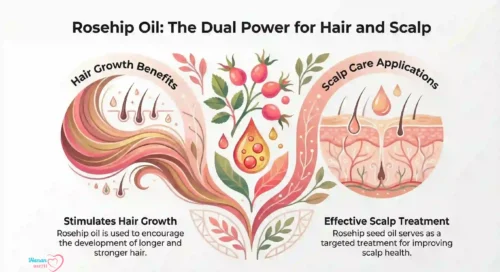
The trans-retinoic acid naturally present in rosehip oil has been studied for its ability to support dermal papilla cells — the cells at the base of the follicle that trigger hair growth. Research published in dermatology journals has shown that topical retinoids can improve hair density and thickness over time.
Additionally, improved scalp circulation (thanks to Vitamin E) means hair follicles receive more oxygen and nutrients, creating a healthier environment for growth. It’s not an overnight miracle, but consistent use over 8–12 weeks shows measurable results for many users.
Fighting Scalp Inflammation
A healthy scalp is the foundation of healthy hair. Full stop. And inflammation — whether from dandruff, seborrheic dermatitis, psoriasis, or just general sensitivity — is the number one enemy of a thriving scalp.
Omega-3 fatty acids (alpha-linolenic acid) are well-documented anti-inflammatory agents. When applied topically, they can help soothe redness, reduce flaking, and calm an irritated scalp environment. Studies on omega-3 supplementation and scalp health consistently support their anti-inflammatory role.
Reader Note: If you have a diagnosed scalp condition, use rosehip oil as a complementary therapy, not a replacement for medical treatment. Always consult a dermatologist.
Reducing Frizz and Improving Shine
Frizz is essentially your hair’s SOS signal — it happens when hair is porous or damaged and absorbs excess humidity from the environment. By reinforcing the cuticle with essential fatty acids, rosehip seed oil reduces that porosity. The result? Smoother strands that reflect light better, giving you that glossy, salon-worthy shine.
Unlike heavy silicone-based serums that create the illusion of shine through buildup, rosehip seed oil creates genuine structural improvement. It works with your hair, not just on top of it.
Strengthening Hair Strands
Breakage is often a sign of protein-lipid imbalance in the hair shaft. While rosehip oil isn’t a protein treatment, it restores the lipid component of that balance. The Vitamin E content also helps neutralize free radicals that weaken hair bonds over time, particularly from UV exposure and pollution.
Think of it this way: if your hair were a rope, free radicals are constantly fraying individual fibers. Antioxidants from rosehip seed oil act like a protective coating, slowing down that degradation.
Rosehip Oil vs. Other Hair Oils: How Does It Compare?
Great question. Let’s put it side by side with some popular alternatives:
| Oil | Key Benefit | Best For | Comedogenic Rating |
|---|---|---|---|
| Rosehip Seed Oil | Growth, moisture, scalp health | All types, especially damaged | Low (0–1) |
| Argan Oil | Frizz control, shine | Dry, color-treated hair | Low (0) |
| Castor Oil | Thickness, density | Thinning hair, edges | High (1) |
| Coconut Oil | Deep conditioning | Coarse, thick hair | High (4) |
| Jojoba Oil | Scalp balance, sebum regulation | Oily scalp | Low (2) |
Rosehip seed oil stands out because it’s one of the few oils that addresses both scalp health and hair strand quality simultaneously, while remaining lightweight enough for most hair types.
How to Use Rosehip Seed Oil for Hair
Knowledge without application is useless. Here’s how to actually incorporate rosehip seed oil into your routine.
As a Pre-Shampoo Treatment
Apply 4–6 drops of rosehip seed oil directly to dry hair, focusing on the mid-lengths and ends. Massage gently, cover with a shower cap, and leave for 20–30 minutes before shampooing. This method protects hair from the drying effects of shampoo while delivering concentrated nutrients.
As a Scalp Massage Oil
Warm 5–8 drops in your palms and use your fingertips to massage the oil into your scalp in circular motions for 5–10 minutes. This improves blood circulation and allows the oil to reach the follicles directly. Do this 2–3 times per week for optimal results.
Mixed into Your Conditioner
Add 3–4 drops of rosehip seed oil to your regular conditioner and apply as usual. This is one of the easiest ways to introduce the oil without overhauling your routine — perfect for beginners.
Pro Tip: Start with less than you think you need. A little goes a long way, and using too much can leave hair feeling greasy, especially on fine hair types.
Who Should Use Rosehip Seed Oil for Hair?
The good news is that rosehip seed oil is genuinely versatile. Here’s a quick breakdown:
- Dry or damaged hair Absolutely yes — this is where it shines brightest.
- Color-treated hair Yes — it helps restore lipids stripped by chemical processing.
- Fine or oily hair Use sparingly, primarily on ends and scalp (not mid-lengths).
- Curly or coily hair Yes — its moisture-sealing properties are excellent for high-porosity curl patterns.
- Sensitive scalps: Generally safe, but patch test first.
Potential Side Effects and Precautions
Rosehip seed oil is considered very safe for topical use, but a few things to keep in mind:
- Oxidation- Rosehip oil is high in polyunsaturated fats, which means it oxidizes (goes rancid) faster than other oils. Store in a cool, dark place and use within 6 months of opening.
- Allergic reactions- Rare, but possible, especially in those with rose or plant allergies. Always do a patch test.
- Comedogenicity on scalp- While generally non-comedogenic, those prone to scalp acne (folliculitis) should monitor their scalp after use.
- Pregnancy- Consult a healthcare provider before using products with significant Vitamin A content during pregnancy.
How to Choose the Best Rosehip Seed Oil
Not all rosehip seed oils are created equal. Here’s what to look for on the label:
- Cold-pressed — ensures nutrient retention.
- Unrefined or virgin — minimal processing.
- Organic certification — reduces pesticide residue risk.
- Dark glass bottle — protects against light-induced oxidation.
- 100% pure — no carrier oils or additives unless you want them.
Avoid products that list rosehip oil far down on the ingredient list of a blend — the concentration may be too low to provide real benefit.

Conclusion
Rosehip seed oil isn’t a trend — it’s a genuinely multi-functional, scientifically supported ingredient with real rosehip seed oil benefits for hair that span hydration, growth, scalp health, and strand strength. Whether you’re just starting your hair care journey or looking to level up an already solid routine, this oil deserves a spot on your shelf.
The key is consistency. Like most natural hair treatments, the results are cumulative. Give it 8–12 weeks, use it correctly, and you may just find yourself wondering how you went this long without it.
FAQs
1. Can rosehip seed oil replace a leave-in conditioner?
Not entirely — rosehip seed oil is an oil, not a humectant, so it seals moisture rather than attracting it. It works best after a water-based product or conditioner, following the “LOC” (Liquid-Oil-Cream) method.
2. How long before I see results from using rosehip seed oil for hair growth?
Most users begin noticing tangible differences in scalp health and hair texture within 4–6 weeks. For measurable hair growth differences, expect 8–12 weeks of consistent use.
3. Can I mix rosehip seed oil with essential oils for added benefits?
Yes — rosehip seed oil makes an excellent carrier oil. Pair it with rosemary essential oil (proven to support hair growth) or peppermint essential oil (stimulates circulation). Always dilute essential oils to 1–2%.
4. Is rosehip seed oil safe for color-treated or chemically relaxed hair?
Absolutely. In fact, it’s particularly beneficial for chemically processed hair because it helps replenish the lipids that are stripped during chemical treatments.
5. Why does my rosehip seed oil smell slightly off after a month?
Rosehip seed oil oxidizes faster than most oils due to its high polyunsaturated fat content. A rancid smell indicates oxidation. Always store in a cool, dark location and refrigerate after opening to extend its shelf life.
References:
- Phetcharat, L., et al. (2015). “The effectiveness of a standardized rose hip powder, containing seeds and shells of Rosa canina, on cell longevity, skin wrinkles, moisture, and elasticity.” Clinical Interventions in Aging. https://www.ncbi.nlm.nih.gov/pmc/articles/PMC4655903/
- Bassino, E., et al. (2020). “Protective role of nutritional plants containing flavonoids in hair follicle disruption.” International Journal of Molecular Sciences. https://www.ncbi.nlm.nih.gov/pmc/articles/PMC7226418/
- Almohanna, H.M., et al. (2019). “The role of vitamins and minerals in hair loss.” Dermatology and Therapy. https://www.ncbi.nlm.nih.gov/pmc/articles/PMC6380979/
