

- Advertisement -
Excessive Water Drinking | Dangers, Symptoms &
The Hidden Dangers of Excessive Water Drinking (What Science Really Says)


- Advertisement -
Excessive Water Drinking
We’ve all been drilled with the same advice since childhood — drink more water, stay hydrated, carry a bottle everywhere you go. And yes, hydration is genuinely critical to your health. But here’s a question that almost nobody asks: can you actually drink too much water? The answer, perhaps surprisingly, is an emphatic yes. Excessive water drinking is a real, medically recognized phenomenon that can cause serious harm — and in rare cases, it can even be fatal. In a wellness culture that endlessly promotes “drink more water,” it’s worth taking a much closer, more honest look at what happens when that advice gets taken too far.
This article covers everything you need to know about excessive water drinking — from the science of what happens inside your body to the surprising psychological and medical conditions that drive it. We’ll explore who’s most at risk, what symptoms to watch out for, and how doctors approach treatment. Whether you’re an endurance runner, someone managing a mental health condition, or simply a health-conscious person wondering if their 16-cup-a-day habit is too much, this guide has you covered.

Understanding Excessive Water Drinking
What Is “Too Much” Water?
Pinpointing exactly where “healthy hydration” ends and “excessive water drinking” begins isn’t a simple, one-size-fits-all equation. Your body is a highly dynamic system, and your water needs shift constantly based on your body weight, physical activity, climate, and overall health status. That said, medical experts have identified general thresholds beyond which most adults begin to experience physiological stress from too much water intake.
Drinking more than 3–4 liters rapidly can be excessive for most adults, though individual tolerance varies depending on body size and kidney function. Liv Hospital Think of your kidneys as a drain pipe with a maximum flow rate — if you pour water in faster than the drain can handle it, things start to back up. The kidneys can only remove 0.8 to 1.0 liters of water per hour, and a very high water intake can upset the body’s electrolyte balance. Medical News Today This is the hard physiological ceiling you’re working against every time you chug water. Pouring a gallon of water into your body over a couple of hours sounds dramatic, but it’s exactly the kind of thing that happens in endurance athletic contexts — and it’s exactly when things can go dangerously wrong.
It’s also important to understand that excessive water drinking is not a single, monolithic problem. It manifests differently depending on whether someone is a marathon runner who over-hydrated during a race, a psychiatric patient with a compulsive drinking disorder, or simply a wellness-enthusiast who took the “8 glasses a day” advice way too literally. All of these scenarios exist on a spectrum, and all are worth understanding in depth.
How Your Kidneys Handle Water Intake
Your kidneys are the unsung heroes of your hydration story. The human body is made up of up to 60 percent water, and sodium (an electrolyte) plays a critical role in regulating how much water moves in and out of your cells. CareSpot When you drink a normal amount of water, your kidneys process the excess and excrete it as urine — a neat, efficient system. In a day, your body removes excess water through urine, which equals about 32 to 64 ounces (about 1 to 2 liters). Cleveland Clinic
But when you start drinking well beyond your body’s needs, particularly in a short window of time, the kidneys simply cannot keep up. Usually healthy kidneys eliminate 1 liter of water per hour or about 20 liters per day, but stress and disease can significantly reduce this capacity. ScienceDirect Once intake exceeds the kidneys’ excretory limit, the excess water floods the body’s tissues and bloodstream, diluting the critical electrolytes — especially sodium — that your cells depend on to function. This is when the body starts sending danger signals, and why understanding kidney limitations is the first step to understanding the real risks of drinking too much water.
The Science Behind Water Intoxication (Hyponatremia)
What Happens to Your Blood Sodium?
The medical term for the condition caused by excessive water drinking is hyponatremia — a word derived from the Greek and Latin for “insufficient sodium in the blood.” It might sound like a niche clinical term, but it’s actually the central mechanism behind nearly every serious complication that comes from drinking too much water. Drinking too much water dilutes your blood and decreases the electrolytes in your body, especially sodium. As a result, water moves into your body’s cells and causes them to swell. Cleveland Clinic
Sodium is not just a seasoning you add to food — it’s a crucial electrolyte that governs the movement of fluids across cell membranes, supports nerve transmission, and keeps your muscles contracting and relaxing properly. Hyponatremia means the blood has too little sodium, with levels dropping below 135 millimoles per liter, and can be dangerous if not treated quickly. Liv Hospital When sodium drops, the osmotic balance between the inside and outside of your cells becomes disrupted. Water rushes into cells seeking equilibrium, causing them to swell. Most cells in your body can expand to some degree without catastrophic consequences — but your brain cells are encased in a rigid skull with almost no room to expand. That’s where things get truly dangerous.
The body must maintain an appropriate balance between sodium and potassium to keep the heart, cells, and nervous system working properly, and water intoxication disrupts this balance. When this happens, you may feel drunk, dizzy, or confused. Stamford Health This electrolyte disruption can cascade rapidly, which is why recognizing hyponatremia early and understanding its biochemical roots is so important — especially for athletes, caregivers, and healthcare providers.
Cellular Swelling and Brain Pressure
When we talk about the dangers of excessive water consumption, the brain is always the organ at the center of the most alarming outcomes. When a person consumes an excessive amount of water and cells in their brain start to swell, the pressure inside their skull increases, causing the first symptoms of water intoxication. Medical News Today Imagine trying to inflate a balloon inside a sealed box — eventually, something has to give. In this case, “something giving” means your brain tissue getting compressed against the inside of your skull.
A buildup of fluid in the brain is called cerebral edema. This can affect the brain stem and cause central nervous system dysfunction. In severe cases, water intoxication can cause seizures, brain damage, a coma, and even death. Medical News Today The brainstem, which controls your most fundamental life-sustaining functions like breathing and heart rate, is particularly vulnerable. This is why severe water intoxication can progress so rapidly from “feeling a bit confused” to a genuine life-threatening emergency. The timeline from symptom onset to serious neurological crisis can be shockingly brief, especially when someone is drinking large volumes of water quickly.

Recognizing the Symptoms of Overhydration
Early Warning Signs
One of the trickiest aspects of overhydration is that its early symptoms look almost identical to those of dehydration — which is precisely why it gets misdiagnosed, especially in athletic settings. Knowing how to tell the difference could genuinely save a life. The good news is that your body does give you clear early signals that something is off, as long as you know what to look for.
The symptoms of overhydration can look like those of dehydration. When you have too much water in the body, the kidneys can’t remove the excess liquid, leading to nausea, vomiting, and diarrhea. Excess water in the body causes the body’s salt levels to go down and the cells to swell, causing throbbing headaches, and the swollen cells in the brain press against the skull. WebMD Beyond headaches and nausea, one of the most revealing early signs is the color of your urine. If your urine is concentrated and looks dark yellow or orange, you need to drink more. If it’s pale yellow, you’re well hydrated. Clear urine could indicate too much water intake, which could lead to hyponatremia or water intoxication. Stamford Health Urine that looks completely colorless is your kidneys practically waving a red flag at you.
Drinking too much water causes your kidneys to work too hard to remove the excess amount, creating a hormonal reaction that makes you feel stressed and tired. WebMD So if you’re feeling inexplicably exhausted, experiencing persistent headaches, and notice that you’ve been running to the bathroom far more than usual, it’s worth honestly evaluating whether your water intake has gotten out of hand. On average, you should urinate six to eight times a day. Going up to 10 times is normal for heavy water drinkers or people who regularly drink caffeine or alcohol. WebMD Anything significantly beyond that warrants attention.
Severe and Life-Threatening Symptoms
As water intoxication progresses from mild overhydration to severe hyponatremia, the symptoms escalate dramatically in both severity and urgency. This is no longer a matter of feeling vaguely off — this is a medical emergency requiring immediate intervention. Without treatment, severe water intoxication symptoms may progress and can include changes to mental status such as confusion, irritability, and dizziness, as well as muscle weakness, muscle pain, muscle cramps, and swelling (edema) in your hands, feet, and belly. Cleveland Clinic
The neurological decline associated with severe hyponatremia can be terrifyingly rapid. A person may go from appearing simply confused or disoriented to experiencing full-on seizures within a matter of hours. Brain herniation — where swelling literally pushes brain tissue through the base of the skull — is the ultimate catastrophic outcome and is uniformly fatal without emergency neurosurgical intervention. Psychogenic polydipsia can lead to mortality in half of severe cases because of cerebral edema and central nervous system dysfunction with delirium, seizures, coma, and death. ScienceDirect This stark statistic underscores just how seriously medical professionals take severe cases of excessive water drinking — it’s not an exaggerated risk.
Who Is Most at Risk for Excessive Water Drinking?
Athletes and Endurance Sportspeople
If there’s one demographic that consistently appears in the medical literature on water intoxication, it’s endurance athletes. Marathon runners, triathletes, long-distance cyclists, and military personnel on extended exercises face a unique combination of risk factors — extreme physical exertion, heavy sweating, peer culture pressure to stay hydrated, and sometimes incorrect guidance about fluid intake that together create dangerous conditions.
The Military Health System and Defense Health Agency reported 1,812 cases of exertion-related hyponatremia between 2008 and 2023 among active service members. Medical News Today That’s a staggering number that speaks to just how prevalent this problem is in high-intensity physical contexts. A 2015 report found that excess water consumption during a hot-weather 40-kilometer marching exercise caused a fatal outcome rather than prevented it — the soldier consumed almost 13 liters of water during the exercise when peers drank closer to 10 liters. Medical News Today The tragic irony here is almost unbearable — trying desperately to stay safe led directly to fatal harm. Marathon runners and other elite athletes are careful to rotate their water intake with electrolyte drinks to maintain the balance of salt and other minerals in their bodies. Stamford Health This electrolyte rotation strategy is now considered standard best practice in sports nutrition and medicine.
Psychogenic Polydipsia and Mental Health Conditions
One of the most complex and often overlooked aspects of excessive water drinking is its relationship with mental health. Psychogenic polydipsia (PPD) — also called compulsive water drinking or self-induced water intoxication — is a condition in which a person feels a powerful psychological compulsion to drink water that has no basis in genuine physical thirst. Psychogenic polydipsia is a condition where someone drinks excessive amounts of water driven by a psychological compulsion rather than physical thirst, and it is most common in people with mental health conditions like schizophrenia, anxiety disorders, or developmental disabilities. Rite Aid
Psychogenic polydipsia is found in patients with mental illnesses, most commonly schizophrenia, but also anxiety disorders and rarely affective disorders, anorexia nervosa, and personality disorders. Wikipedia The numbers within psychiatric inpatient populations are striking: PPD occurs in between 6% and 20% of psychiatric inpatients. Wikipedia Researchers believe that brain chemistry disruptions — particularly involving dopamine and cholinergic systems — play a central role. In psychogenic polydipsia, improper functioning of the dopaminergic and cholinergic system has been implicated, which results in dysregulation of the thirst center along with the involvement of the hippocampal region, leading to this behavior of constant drinking. NCBI
Treatment is notoriously difficult. The illness generally develops in three phases, beginning with polydipsia and polyuria, followed by hyponatremia (where the kidneys fail to excrete the excess fluid, resulting in low sodium levels), and finally water intoxication that may manifest as nausea, vomiting, delirium, ataxia, seizures, coma, and may even be fatal. PubMed Central Managing this condition requires a coordinated psychiatric and medical team approach, combining fluid restriction, behavioral therapy, medication adjustments, and in some cases, pharmacological interventions. Some studies have indicated that bupropion and naltrexone have some benefits with compulsive drinking associated with psychogenic polydipsia. Oxford Academic
Habitual Polydipsia — The Wellness Culture Problem
Here’s a risk factor that rarely gets discussed in mainstream health conversations: habitual polydipsia, sometimes called dipsogenic polydipsia. This is the compulsive overdrinking of water not because of psychiatric illness, but because of a deeply held — and medically inaccurate — belief that drinking as much water as possible is inherently good for your health. Sound familiar? It should, because wellness culture has been actively promoting this idea for years.
Habitual polydipsia comes under dipsogenic polydipsia and is seen in individuals who are under the impression that drinking copious amounts of water will maintain good health, which is on the rise in recent years. NCBI Think about the explosion of giant 64-ounce and 128-ounce water bottles that have become cultural icons, the viral “water challenges” on social media, and the endless parade of fitness influencers insisting their glowing skin and energy come from drinking a gallon of water per day. For the vast majority of healthy adults, this is not dangerous — their kidneys can compensate. But dipsogenic polydipsia prevalence is increasing in the general population with the advent of healthy lifestyle programs. NCBI
The problem is compounded by the fact that individual water needs vary enormously. What’s too much for a sedentary 120-pound woman in a cool climate is genuinely insufficient for a 200-pound construction worker in summer heat. Applying a blanket “drink as much as possible” approach without considering personal physiological context is, at best, unnecessary and, at worst, medically counterproductive. Your kidneys are not a luxury organ that benefits from being overworked — they’re a precision instrument that functions best within a healthy operating range.
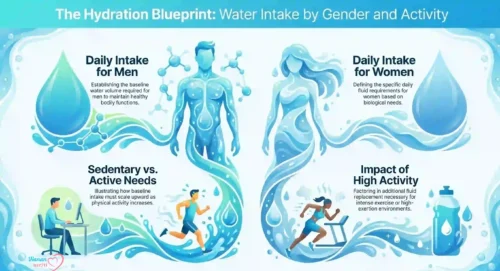
Daily Water Intake: How Much Do You Actually Need?
Recommended Intake by Gender and Activity
So now that we’ve thoroughly established the dangers of drinking too much water, let’s answer the question you’ve probably been asking: how much water should you actually drink per day? The truth is there’s no universal magic number, but medical institutions have developed solid evidence-based guidelines to work from.
| Population Group | Recommended Daily Fluid Intake |
|---|---|
| Adult Men (general) | ~15 cups (3.5 liters) including food |
| Adult Women (general) | ~11 cups (2.7 liters) including food |
| Pregnant Women | 10–12 cups per day |
| Endurance Athletes | Individually adjusted; rotate with electrolytes |
| Infants (0–6 months) | Breast milk/formula only; no additional water |
The human body needs 30 milliliters of fluid per kilogram of body weight — that’s about eight 8-ounce glasses, or 64 ounces of fluid daily. Stamford Health Keep in mind that this total fluid intake includes water from all sources — not just what you drink from a glass, but also the moisture content in fruits, vegetables, soups, and even coffee and tea. Coffee and tea, even with cream and sugar, count toward your fluid intake — the old myth that coffee didn’t count because of its diuretic properties has been debunked. Stamford Health That’s genuinely good news for the world’s coffee lovers.
The Urine Color Test
Forget expensive hydration monitors and fancy apps — your own urine gives you the most reliable real-time feedback on your hydration status absolutely free of charge. Think of it like a biological dashboard. If you’re properly hydrated, your urine will be light yellow. You may be drinking too much water if your urine is colorless or clear, and you should stop drinking water if your pee is colorless and you have water intoxication symptoms. Mayo Clinic
Dark amber or orange urine signals significant dehydration and tells you to drink more. Pale straw-colored urine — something like light lemonade — is exactly what you’re aiming for. Completely clear, water-like urine is a red flag that you’re overdoing it. This simple, zero-cost test is something every person who cares about their hydration should build into their daily routine. It takes literally zero extra effort and can tell you more about your fluid balance than most commercial hydration products on the market.
Comparing Overhydration vs. Dehydration
Because the symptoms of both conditions can overlap significantly, here’s a direct comparison to help clarify what you might be experiencing:
| Feature | Overhydration | Dehydration |
|---|---|---|
| Urine Color | Clear/Colorless | Dark Yellow/Amber |
| Urination Frequency | Very high (10+ times/day) | Low |
| Sodium Levels | Low (hyponatremia) | Often elevated |
| Headache | Yes (from cell swelling) | Yes (from fluid loss) |
| Nausea | Common | Common |
| Confusion | In severe cases | In severe cases |
| Swelling | Yes (hands, feet, belly) | No |
| Primary Risk | Water intoxication, seizures | Organ damage, heat stroke |
| Treatment | Reduce water, restore electrolytes | Drink fluids, replenish salts |
This table makes clear why diagnosis matters so much in emergency athletic or psychiatric contexts — the treatments for the two conditions are essentially opposite. Giving more fluids to someone already suffering from hyponatremia can be catastrophic.
Medical Conditions That Cause Excessive Thirst
It’s important to distinguish between excessive water drinking as a behavioral or psychiatric issue and excessive thirst driven by underlying medical conditions. Several diseases cause a genuine, physiologically driven increase in thirst — and these need to be ruled out before attributing polydipsia purely to habit or psychology.
Diabetes mellitus is the most common culprit. When blood sugar levels run persistently high, the kidneys work overtime to filter and excrete excess glucose, pulling enormous amounts of water with it, which triggers extreme thirst. Diabetes insipidus — a completely different condition despite the similar name — involves a problem with either the pituitary gland’s production of antidiuretic hormone or the kidneys’ response to it, resulting in the production of massive volumes of dilute urine and a corresponding desperate thirst. Extreme thirst is most often associated with diabetes, and if you experience persistent extreme thirst that isn’t connected to activity or heat, visiting a healthcare professional is important. CareSpot
Other medical conditions that can drive excessive thirst include congestive heart failure, chronic kidney disease, and certain adrenal disorders like Addison’s disease. Some psychiatric medications — particularly many antipsychotics, antidepressants, and anticonvulsants — cause significant dry mouth as a side effect, which in turn drives patients to drink more water than they physiologically need. Dry mouth is often a side effect of medications used in the treatment of some mental disorders, rather than being caused by the underlying condition itself, and such medications include antipsychotics, antidepressants, anticonvulsants, and anticholinergics. Wikipedia This medication-driven cycle is one of the most clinically challenging aspects of managing water intake in psychiatric populations.
Treatment and Prevention of Excessive Water Drinking
Medical Treatment Options
When excessive water drinking has already led to symptomatic hyponatremia or water intoxication, medical treatment focuses on restoring the sodium balance safely and quickly — but not too quickly, as rapid correction of hyponatremia carries its own serious risks, including osmotic demyelination syndrome. When symptoms are more severe, treatment uses diuresis to increase urination, intravenous saline to balance sodium electrolytes, and vasopressin receptor antagonists. ScienceDirect
For patients with psychogenic polydipsia, treatment is significantly more complex because you’re dealing with both the medical consequences of overhydration and the underlying psychiatric condition driving it. The management of psychogenic polydipsia normally involves fluid restriction and behavioral therapy. Oxford Academic Some emerging pharmacological options show promise — there is evidence for the role of naltrexone in reducing compulsive drinking behavior in psychogenic polydipsia patients. Oxford Academic Atypical antipsychotics like clozapine and olanzapine are also used in some cases to help regulate the dopaminergic pathways that contribute to compulsive behavior. The honest clinical reality, though, is that there is not one particular proven strategy for treating primary polydipsia, and various classes of drugs have been studied with none being definitively effective. NCBI
Practical Prevention Tips
For the vast majority of people who are not dealing with psychiatric illness or acute medical conditions, preventing excessive water drinking is largely a matter of cultivating body awareness and replacing cultural myths with physiological facts. Here are the most actionable, evidence-based strategies:
- Drink to thirst, not to a schedule. Your body’s thirst mechanism is remarkably well-calibrated for most healthy adults. Listening to your body, drinking when you’re thirsty, and stopping after you’ve quenched your thirst rather than forcing yourself to drink is the most reliable guide. Cleveland Clinic
- Use the urine color test daily. Aim for light straw yellow — not clear, not dark amber.
- Adjust intake based on context. Hot weather, intense exercise, illness, and pregnancy all increase your needs. A cool office day does not require the same intake as a two-hour run.
- Rotate water with electrolytes during endurance exercise. If you’re exercising hard for more than 60–90 minutes, plain water alone is not sufficient — you need to replenish sodium and other electrolytes.
- Be skeptical of extreme hydration challenges. A “gallon a day” challenge might be harmless for some individuals in certain conditions, but it’s not medically necessary and can be harmful for others.
- If you’re on psychiatric medications, monitor your fluid intake proactively. Discuss any dry mouth side effects with your prescribing physician — there may be medication adjustments or salivary substitutes that reduce the urge to drink excessively.

Conclusion
Excessive water drinking sits at a strange intersection of cultural mythology and genuine medical risk. We’ve been taught that water is unconditionally good, and while that’s true in the right amounts, the science is unambiguous: too much water, taken too quickly, can overwhelm your kidneys, dilute your blood sodium to dangerous levels, and in worst-case scenarios, kill you. The conditions under which this happens — marathon running, psychiatric illness, misguided wellness extremism, certain medical conditions — are more common than most people realize.
The takeaway isn’t to fear water. Hydration is genuinely essential and the vast majority of people actually under-hydrate rather than over-hydrate. The real lesson is that moderation, body awareness, and context are everything. Drink when you’re thirsty. Respect your kidneys’ processing limits. Learn to read your urine color like the health dashboard it actually is. And if you’re an athlete, a caregiver for someone with a psychiatric condition, or someone who notices relentless thirst that doesn’t resolve with normal drinking, take those signs seriously and bring them to a qualified healthcare provider. Your water bottle is your friend — just don’t let it become your adversary.
Frequently Asked Questions (FAQs)
1. How much water is considered excessive in a single day?
There’s no one-size-fits-all answer, but drinking more than 3–4 liters in a short period of time is generally considered excessive for most adults. Individual tolerance varies based on body size, kidney function, activity level, and climate. Consistently drinking beyond what thirst demands — especially if your urine is consistently clear — is a meaningful warning sign worth discussing with a doctor.
2. Can drinking too much water cause permanent kidney damage?
Acute water intoxication primarily threatens the brain through sodium dilution and cellular swelling rather than causing direct permanent kidney damage in most cases. However, chronic excessive water consumption, particularly in cases of psychogenic polydipsia, can strain the kidneys over time and in severe cases contribute to conditions like hydronephrosis (fluid buildup in the kidneys) and even renal insufficiency.
3. Is the “8 glasses of water a day” rule scientifically accurate?
Not exactly — it’s a reasonable ballpark estimate for many adults but lacks scientific precision. Total fluid needs depend on body weight, activity, climate, diet, and health status. Fluid from food (fruits, vegetables, soups) also counts toward your daily total. The best real-time guide remains urine color: pale straw yellow means you’re doing well.
4. What’s the difference between psychogenic polydipsia and just drinking a lot of water?
Psychogenic polydipsia involves a psychiatric compulsion to drink water that is disconnected from actual physiological thirst — patients often drink several gallons per day and may feel intense anxiety when unable to access water. It’s classified as a medical condition most commonly associated with schizophrenia, bipolar disorder, and anxiety disorders. Simply drinking more water than average due to exercise, heat, or personal preference is not the same thing.
5. What should I do if I think I or someone else has water intoxication?
Stop drinking water immediately and seek emergency medical attention without delay. Symptoms like confusion, severe headache, nausea, vomiting, seizures, or loss of consciousness after excessive water intake require urgent evaluation and treatment. Do not wait for symptoms to “pass on their own” — severe hyponatremia is a medical emergency where time-to-treatment directly affects outcomes.
References:
- Cleveland Clinic — Water Intoxication: https://my.clevelandclinic.org/health/diseases/water-intoxication
- Medical News Today — Water Intoxication: https://www.medicalnewstoday.com/articles/318619
- Mayo Clinic — Water: How Much Should You Drink?: https://www.mayoclinic.org/healthy-lifestyle/nutrition-and-healthy-eating/in-depth/water/art-20044256
- NCBI/NIH — Primary Polydipsia (StatPearls): https://www.ncbi.nlm.nih.gov/books/NBK562251/
- WebMD — What Happens When You Drink Too Much Water?: https://www.webmd.com/diet/what-is-too-much-water-intake
