

- Advertisement -
What Is Normal Weight Gain for Newborns? A Pediatrician-Backed Guide
Newborn Weight Gain by Week| What's Normal, What's Not & When to Worry


- Advertisement -
Normal Weight Gain for Newborns
If you’ve ever stood in a pediatrician’s office watching a nurse place your tiny baby on a scale and felt your heart rate spike waiting for the verdict — you’re not alone. For new parents, normal weight gain for newborns is one of the most talked-about, most Googled, and most anxiety-inducing topics in all of early parenthood. Is my baby gaining enough? Did she lose too much? Why is she still lighter than my friend’s baby? The questions are endless, and the stakes feel enormous. But here’s the reassuring truth: newborn weight gain follows a beautifully predictable pattern, and understanding that pattern will replace your anxiety with confidence. This guide covers everything you need to know — from birth weight averages to monthly milestones, from growth chart interpretation to feeding strategies — so you can track your baby’s progress like a pro.
What Is the Average Birth Weight for Newborns?
Before we can talk about gaining weight, we need to establish a baseline. The average weight for full-term babies is approximately 7 pounds, 5 ounces. Healthline That said, “average” doesn’t mean “required,” and a healthy birth weight covers a much wider spectrum than most parents realize. Most babies born between 37 and 40 weeks weigh somewhere between 5 pounds, 8 ounces (2,500 grams) and 8 pounds, 13 ounces (4,000 grams). KidsHealth Newborns outside this range aren’t automatically in trouble — they just get a little extra attention from doctors and nurses to rule out any underlying concerns.
Think of birth weight like shoe size: there’s a standard range, but plenty of perfectly healthy people fall outside the middle of the bell curve. What matters far more than hitting an exact number is whether your baby is growing consistently from wherever they started.
Birth Weight Ranges Considered Healthy
When pediatricians talk about healthy birth weight, they generally use a tiered system. A baby weighing less than 5 pounds, 8 ounces is classified as low birth weight, while those over 8 pounds, 13 ounces are considered larger than average. The average birth weight of a full-term male baby is 3.3 kilograms (kg) and 3.2 kg for a female. Medical News Today Boys tend to run slightly heavier, and that trend often continues well into the first year of life. Importantly, a baby’s position on the weight spectrum at birth doesn’t dictate how they’ll grow — a small baby can thrive and a large baby can have challenges, and vice versa. The trajectory of growth over time tells a far more meaningful story than any single reading on a scale.
Factors That Influence Birth Weight
Birth weight isn’t random — it’s shaped by a complex web of biological, environmental, and genetic forces. Genetics play a major role: parents that are bigger tend to have big babies, and smaller parents tend to have small babies. The Bump Beyond genetics, the conditions inside the womb are profoundly influential. Mothers with elevated blood sugars or gestational diabetes may have bigger babies, while compromised blood flow during pregnancy — whether from a narrow umbilical cord or placental issues — can result in babies born on the smaller side. KidsHealth Maternal nutrition, smoking, alcohol use, and chronic health conditions all leave their fingerprints on a baby’s birth weight. Understanding these factors helps parents make sense of where their child lands on the spectrum without unnecessary guilt or worry.

The Initial Weight Drop — Why Your Newborn Loses Weight First
Here’s something that catches many parents completely off guard: your newborn is supposed to lose weight right after birth. Yes, you read that correctly. The scale going down in those first days is not a crisis — it’s completely normal physiology, and panicking about it would be like panicking because the tide went out. Every healthy baby does this, and every healthy baby bounces back.
How Much Weight Loss Is Normal?
A baby may lose up to 10 percent of their birth weight in the days or week after birth. The Bump This happens because newborns are born with extra fluid in their bodies that they gradually shed in those early days. They’re also still figuring out feeding, whether at the breast or bottle, which means their caloric intake in the first 48–72 hours is relatively minimal. A healthy newborn is expected to lose 7% to 10% of their birth weight, but should regain that weight within the first 2 weeks or so after birth. KidsHealth So if your baby weighed 7 pounds, 5 ounces at birth and comes home at 6 pounds, 12 ounces, that’s entirely within the normal range — don’t let that number send you into a spiral.
When Should Baby Regain Birth Weight?
The two-week mark is the standard medical benchmark, but many babies regain their birth weight even sooner. By the time they’re 2 weeks old, they should have their first growth spurt and be back up to their birth weight. The Bump If your baby hasn’t regained their birth weight by two weeks, that’s worth a conversation with your pediatrician — not necessarily an emergency, but a signal to dig a little deeper into feeding patterns and nutrition. Your baby’s doctor will likely ask detailed questions about how often your little one is feeding, how long each session lasts, and what the diaper output looks like, since wet and soiled diapers are one of the most reliable indicators that a baby is getting enough nutrition.
Normal Weight Gain for Newborns Week by Week
Once the initial weight loss and recovery phase is complete, babies shift into what many parents describe as the “eating machine” phase. The rate of weight gain in the early weeks of life is genuinely remarkable — faster than at almost any other point in a human being’s entire life. Understanding what to expect during this period helps you gauge whether your baby is on track without constantly second-guessing every ounce.
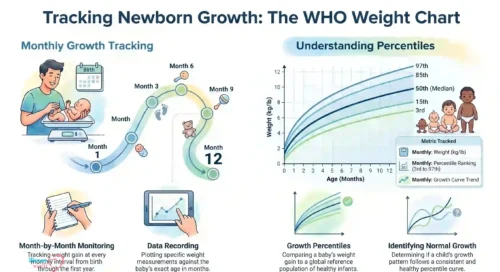
During their first month, most newborns gain weight at a rate of about 1 ounce (30 grams) per day. KidsHealth That translates to roughly half a pound to a full pound per week in those early weeks — which, when you think about it relative to body size, is extraordinary. A 10-pound adult gaining weight at the same proportional rate would be packing on about 1.5 pounds every single day. In the first three months of life, infants will average about half to one ounce of weight gain per day. The growth rate will then decrease to about 0.67 ounces of weight gain daily. At the six-month mark, the rate drops to about 0.33 ounces a day. The Bump
Month-by-Month Weight Gain Chart
The table below gives you a general framework for expected weight at each stage of the first year, based on WHO growth data for both male and female babies:
| Age | Average Weight (Boys) | Average Weight (Girls) | Expected Monthly Gain |
|---|---|---|---|
| Birth | 7.6 lbs (3.3 kg) | 7.3 lbs (3.2 kg) | — |
| 1 Month | 9.9 lbs (4.5 kg) | 9.2 lbs (4.2 kg) | ~1.5–2 lbs |
| 2 Months | 12.3 lbs (5.6 kg) | 11.5 lbs (5.1 kg) | ~1.5–2 lbs |
| 3 Months | 14.1 lbs (6.4 kg) | 12.8 lbs (5.8 kg) | ~1–1.5 lbs |
| 4 Months | 15.4 lbs (6.7 kg) | 14.1 lbs (6.4 kg) | ~1 lb |
| 6 Months | 17.6 lbs (8.0 kg) | 16.1 lbs (7.3 kg) | ~1 lb |
| 9 Months | 20.1 lbs (9.1 kg) | 18.4 lbs (8.4 kg) | ~0.75 lb |
| 12 Months | 22.5 lbs (10.2 kg) | 20.9 lbs (9.5 kg) | ~0.5 lb |
Note: These are approximate 50th percentile values. Your baby’s healthy weight may differ significantly and still be perfectly normal.
As a general rule, infants should be at double their birth weight at 4 months and triple their birth weight by 12 months. The Bump These two milestones serve as useful gut-check benchmarks for parents tracking growth at home.
Growth Spurts: What They Are and When They Happen
Growth spurts are your baby’s way of rapidly accelerating development in short, concentrated bursts — think of them like software updates that download all at once rather than gradually. During a growth spurt, your baby may seem ravenously hungry, unusually fussy, and sleep more than usual (or less — every baby is different). Many newborns go through a period of rapid growth when they are 7 to 10 days old and again at 3 and 6 weeks. KidsHealth After the newborn period, growth spurts tend to cluster around 3 months, 6 months, and 9 months. These aren’t hard-and-fast rules, and some babies have growth spurts that don’t follow the textbook schedule at all. The key is to follow your baby’s hunger cues and feed on demand, trusting that their body knows what it needs.
Breastfed vs. Formula-Fed Babies — Does Feeding Method Matter?
One of the most common points of confusion for new parents is whether breastfed and formula-fed babies are supposed to grow at the same rate. The short answer is: mostly yes, but with some meaningful differences in the early months. Understanding these differences can save a lot of unnecessary worry, especially for breastfeeding parents whose babies seem to be growing differently than formula-fed peers.
Weight Gain Patterns in Breastfed Babies
Breastfed babies commonly gain weight more quickly in the early months and then naturally slow around three to four months. Baby Care Advice This often surprises parents who assume formula-fed babies grow faster because formula is more calorie-dense. The reality is more nuanced. Breast milk composition changes throughout each feeding and across different stages of the baby’s development, providing exactly what the baby needs at each moment. Because of these natural differences in growth patterns, the WHO growth charts — which are based on breastfed babies — are now the preferred standard for children under two in most developed countries.
Weight Gain Patterns in Formula-Fed Babies
Formula-fed babies tend to gain weight at a more linear pace compared to breastfed babies. Bottle-feeding parents should be giving their newborn baby roughly 1 more ounce of formula than their age in months for healthy weight gain — for example, a 1-month-old takes about 2 ounces per feeding every 3 hours, while a 2-month-old takes about 3 ounces. Texas Children’s Formula-fed babies may also be at slightly higher risk for overfeeding because it’s easier to push a bottle than a breast, so watching hunger cues (stopping when the baby turns away or loses interest) is especially important. Weight gain and growth rates can also depend on whether the baby consumes breast milk or formula. However, growth generally follows a similar trend for both feeding methods. Medical News Today

How to Read a Baby Growth Chart
Growth charts can feel like decoding a foreign language the first time you see one, but they’re actually brilliantly simple tools once you understand what you’re looking at. A growth chart doesn’t tell you whether your baby is “good” or “bad” — it tells you where your baby falls relative to other babies of the same age and sex. That’s it. A baby at the 15th percentile for weight isn’t underweight — they’re simply smaller than 85% of babies their age, which is completely normal and healthy as long as they’re following their own consistent curve.
WHO vs. CDC Growth Charts — Which One Should You Use?
This is a question that comes up frequently in pediatric practices, and the answer has become fairly standardized. The Centers for Disease Control and Prevention (CDC) and the American Academy of Pediatrics (AAP) recommend using WHO’s charts for children up to 2 years old. Healthline The reason for this preference is significant: the WHO infant weight-for-age percentile charts are based on data on the growth pattern of breastfed babies, which is considered the biological norm for infant feeding. Baby Care Advice The older CDC charts, by contrast, included a higher proportion of formula-fed babies in their dataset, which skews the growth curves slightly. Using the WHO chart ensures your baby is being compared to a population that reflects current best-practice feeding recommendations.
Signs Your Newborn Is Gaining Weight Well
While the scale is the most obvious tool for tracking your baby’s growth, it isn’t the only one — and it certainly isn’t the most important one on a day-to-day basis. Most parents aren’t weighing their babies daily at home, nor should they be. Instead, there’s a cluster of reliable signs that indicate your newborn is getting enough nutrition and gaining weight appropriately between doctor’s visits.
Wet nappies, feeding behaviour, sleep, age-appropriate milestones, and steady growth are more reliable signals than any number on a chart. Baby Care Advice A well-nourished newborn will produce at least 6 wet diapers per day after the first week of life and will have frequent bowel movements (especially in the early weeks). Beyond diaper output, a thriving baby is alert and engaged during wake windows, feeds actively and vigorously at the breast or bottle, and returns to their birth weight within the expected two-week window. They may have rolls — that chubby, folded appearance that makes grandparents swoon — but even lean, slender babies can be perfectly well-nourished. If your child’s bodily functions are occurring multiple times during the day, that’s a good indication your baby is hydrated and receiving the appropriate milk or formula supply. Texas Children’s
When to Be Concerned About Newborn Weight Gain
Knowing when to relax and when to call the doctor is one of the most valuable skills a new parent can develop. The vast majority of dips or plateaus in newborn weight gain resolve on their own with minor feeding adjustments. But there are specific signs that warrant prompt medical attention, and recognizing them early can make a significant difference in outcomes.
Red flags for inadequate weight gain include: failure to regain birth weight by two weeks of age, weight loss greater than 10% of birth weight, no wet diapers for more than 8 hours, a baby who seems lethargic and difficult to wake for feedings, and persistent feeding difficulties beyond the first week. Babies who don’t grow and gain weight appropriately after birth can have poorer developmental outcomes. The Bump This is not said to frighten parents, but to underscore why pediatric weight monitoring matters — catching a problem early gives the healthcare team time to intervene effectively.
Causes of Poor Weight Gain in Newborns
When a newborn isn’t gaining weight as expected, the cause is almost always one of three categories: inadequate intake, inadequate absorption, or increased metabolic demand. Inadequate intake is by far the most common — a breastfeeding latch issue, low milk supply, or improper formula preparation can all result in a baby not getting enough calories. Health issues that affect nutrient absorption or digestion, such as celiac disease, may also lead to slow weight gain. Medical News Today On the metabolic side, babies with congenital heart irregularities may gain weight more slowly, Medical News Today because the extra work their hearts must do burns through more energy. Premature babies form a special category: babies born prematurely may grow and gain weight more slowly during their first year than babies born at full term. However, many premature babies gain weight rapidly and “catch up” by about their first birthday. Medical News Today
How Pediatricians Track Newborn Growth
Your baby’s growth is one of the most carefully monitored aspects of their early health, and for good reason. From your baby’s first day, doctors will keep track of weight, length, and head size. Growth is a good indicator of general health. Babies who are growing well are generally healthy, while poor growth can be a sign of a problem. KidsHealth The American Academy of Pediatrics recommends well-child visits at 2–3 days after birth (especially for breastfed babies), 1 month, 2 months, 4 months, 6 months, 9 months, and 12 months during the first year of life.
At each visit, your pediatrician isn’t just recording a number — they’re plotting your baby’s trajectory on a growth chart and looking for consistency. A baby who has consistently tracked at the 20th percentile is not a concern; a baby who has dropped from the 60th percentile to the 20th percentile over two appointments warrants investigation. The doctor will also chart baby’s head circumference, which helps them assess brain growth and proper development. The Bump It’s a holistic picture, not a single data point, and good pediatric care always evaluates weight in the context of length, head circumference, development, feeding behavior, and overall wellbeing.
Practical Tips to Support Healthy Weight Gain
Supporting your newborn’s healthy weight gain doesn’t require special products, expensive supplements, or exhausting schedules. It requires a few evidence-based practices applied consistently, starting from the very first days of life. These strategies work whether you’re breastfeeding, formula feeding, or doing a combination of both.
Feed frequently and on demand. Newborns have tiny stomachs — about the size of a marble at birth — and need to feed 8–12 times every 24 hours. Feeding on demand (rather than on a rigid schedule) ensures your baby gets the calories they need while also helping establish and maintain your milk supply if you’re breastfeeding. Ensure a good latch if breastfeeding. A poor latch is the single biggest cause of inadequate weight gain in breastfed newborns, because it means your baby isn’t transferring milk efficiently even if your supply is plentiful. A lactation consultant can be a game-changer here — don’t hesitate to seek one out in the first week. Monitor diaper output. Tracking wet and soiled diapers is your best at-home proxy for adequate nutrition. Fewer than 6 wet diapers per day after day five of life is a sign to call your pediatrician.
Skin-to-skin contact is a beautiful and scientifically supported practice that does far more than feel wonderful — it stimulates feeding hormones, encourages frequent nursing, and helps regulate your baby’s temperature and metabolism. For formula-feeding parents, ensuring accurate preparation is critical; formula that is too diluted provides insufficient calories and can lead to poor weight gain even when feeding volumes seem adequate. Keep a record of feedings (time, duration, or amount) in the first few weeks — this gives your doctor invaluable data at each appointment. According to the American Academy of Pediatrics, exclusive breastfeeding for the first six months is the gold standard for infant nutrition, supporting both healthy weight gain and long-term health outcomes.
Conclusion
Understanding normal weight gain for newborns transforms one of parenthood’s most common sources of anxiety into something manageable and even fascinating. Your newborn will lose weight before they gain it, gain it rapidly, slow down, have growth spurts, and eventually level off — all as part of a predictable, well-researched developmental journey. What matters most, as every expert source confirms, isn’t any single number on a scale, but a consistent growth trend that follows your baby’s own individual curve. A healthy baby should follow their own curve, with steady gains that match their individual needs, body type, and feeding style. Baby Care Advice Trust your pediatrician, trust the process, and trust yourself. You’re doing better than you think.
Frequently Asked Questions (FAQs)
1. How much weight should a newborn gain per day in the first month? Most newborns gain approximately 1 ounce (28–30 grams) per day during the first month of life. This can vary slightly from baby to baby, but a consistent daily gain averaging close to this figure is considered healthy. Your pediatrician will evaluate your baby’s total gain over weeks rather than day by day.
2. Is it normal for a newborn to lose weight in the first week? Yes, it’s completely normal. Newborns typically lose between 7% and 10% of their birth weight in the first few days due to the loss of extra fluids they’re born with and while feeding is being established. This weight should be regained by the time the baby is about two weeks old.
3. My baby is at the 10th percentile for weight — should I be worried? Not necessarily. Percentiles are simply a comparison tool, not a pass/fail grade. A baby consistently tracking at the 10th percentile is growing normally for their body type. The concern arises when a baby’s percentile drops significantly across multiple measurements, not from being in a lower percentile to begin with.
4. Do breastfed babies gain weight differently than formula-fed babies? Yes, there are some differences. Breastfed babies often gain weight more quickly in the first two to three months and then slow down naturally around the four-month mark. Formula-fed babies tend to follow a more linear growth pattern. Both are normal — which is why the WHO growth charts (based on breastfed babies) are recommended as the standard reference for all babies.
5. When should I call the doctor about my baby’s weight gain? Contact your pediatrician if your newborn hasn’t regained their birth weight by two weeks, is losing more than 10% of birth weight, is producing fewer than 6 wet diapers per day after the first week, appears lethargic or difficult to wake for feedings, or if you notice a sharp drop across growth chart percentiles at any well-child visit.
